Monday, January 12, 2015

Heel, Mid Sole or Fore-Foot? What kind of runner are you?

The onset of a New Year sees many people undertaking new fitness resolutions (have you seen the gym in January?? Packed!!) and, running is a cheap and easy way to shift the added Festive Pounds. So, up comes the questions time and again. Where should land on my foot? Most trainers, athletes, coaches, physiologists and sports-shoe companies agree on an all-embracing ‘running posture’; upright postural alignment with a slight forward tilt, a shorter but relaxed arm swing and shorter strides that result in a cadence of 180 steps per minute or higher. However, the position, and timing of one’s foot-fall continues to create differences of opinion. There are distinct differences between heel-striking, mid-foot striking gait and running on your forefoot. However, one is not necessarily better or worse than the other because they are used for different situations. In the ‘big-money’ market of sports retail; the demand by shoe designers and manufacturers means that cash has been thrown at research and many of these studies support the pros and cons of each style, but that shoe-to-ground impact also vary considerably among individual runners. 


So what’s best for you?

My personal style has evolved over the years and I have tried every way of running possible. As a 16 year old girl who ‘decided to get fit’ through running a mile around the block each morning, I was a complete heel striker.  Fast forward 12 years and a few running races and triathlons later, I got fed up of seeing myself looking terribly awkward in the race photos. So I decided to change it. Simple as that (or so I thought) And yes, if you picked up on it. I did in fact change my running style for completely superficial reasons. Not liking the way I looked in race pics! Perhaps not the best reason to change a technique but it actually turned out better for me! My cadence increased and pace picked up; and I found I can react to race situations easily and adapt my pace to suit.


Heel- striker:  If you are reaching or over-striding with your legs, are upright or leaning slightly back as you run, as most people do, you will be heel-striking and most likely pushing off the balls of your feet to propel yourself forward. Its not the most efficient way to run and can cause a host of injuries. During a foot-strike, the impact of the heel, with the ground, generates a significant impact, a shockwave if you will, an immediate and large force that is sent up through the through the body via the skeletal system (oh ‘hello’ knee pain!). However, just because you heel strike, doesn’t mean you have ‘bad-form’, just be aware that it may put you at higher risk of injury. However, with 95% of recreational runners choosing this style of foot-strike; they can’t all be wrong….


Most studies suggest the vast majority of recreational runners are significantly more efficient with a heel-first strike pattern. In a detailed paper published in the Journal of Experimental Biology, scientists calculated joint torque, mechanical work performed, and muscle activity associated with differing initial contact points at various speeds of walking and running. The results of this study showed that walking with a heel-first strike pattern reduced the metabolic cost of walking by 53%! That’s a huge difference in efficiency and it explains why almost all slow joggers (who often run just a little faster than walking pace) make initial ground contact with their heels. So, ease off on your purchase of that pair of minimalist running shoes just a second and read on…..

So why do as many as one-third of the world’s fastest distance runners strike the ground with their mid-foot, if heel-striking is so metabolically advantageous? 

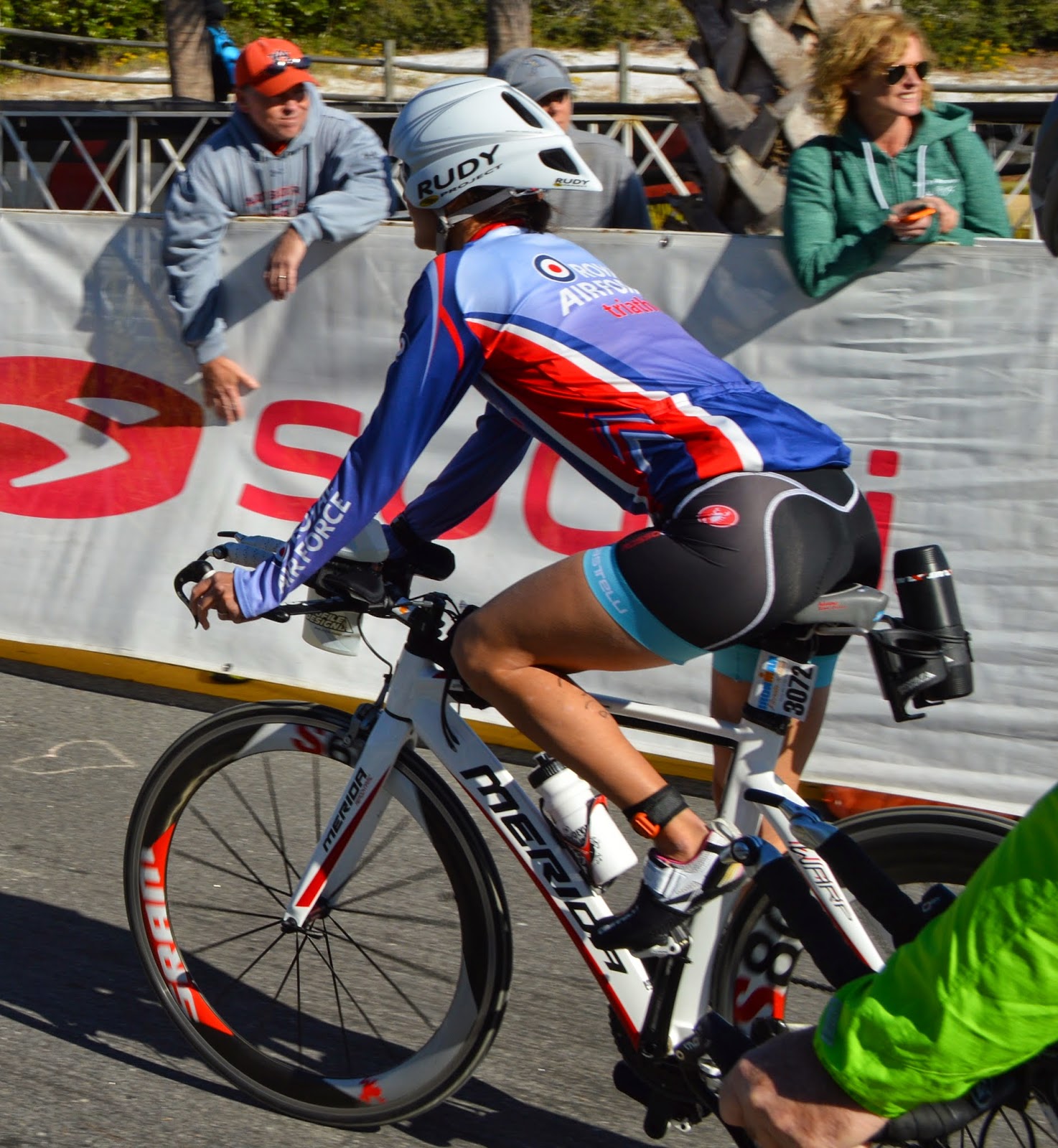
Now is it just me, or is she over-striding a little......? ;)
In a computer simulated study evaluating efficiency, researchers from the University of Massachusetts showed that while running at 7:36 per mile pace, heel striking was approximately 6 percent more efficient than mid or forefoot striking. Some recent research suggests that the 6:25 per mile pace is the transition point at which there is no difference in economy between heel and mid-foot strike patterns. These studies confirm that although highly skilled runners are efficient while landing on their mid or forefeet, the majority of recreational runners are more efficient with a heel-first strike pattern.

Like I said, just because you heel-strike, doesn’t mean you have ‘bad form’ and, as the old adage goes: “if it ain’t broke, don’t fix it”.

So what’s the big deal about bringing our foot-strike forward? I mean, we see photos of athletes on magazine covers in the perfect ‘running’ pose, commercials for minimalist running shoes where the athlete looks as if they are floating along on the mid and fore-foot, like a gazelle bounding through from one foot to the other with defined calves making us green at the gills….

Mid-foot striker: This strike pattern can significantly reduce stress on the knee, and as such, they are a good consideration for runners suffering with recurrent knee pain or lower back pain (many heel-strikers arched their back during a stride). This is especially true for faster runners with wide forefeet and flexible Achilles tendons. (Conversely, runners with a history of Achilles, forefoot, and/or plantar fascial injuries may feel more comfortable opting to stick with initial contact along the outside of the heel). Although a few people naturally fall mid-foot, you may find that it is time to alter your running style to take advantage of this style. Even by moving your foot-strike closer to your body, you may find that your land more on the mid-foot.

Forefoot Striker: In forefoot striking, the impact of the forefoot with the ground generates a very minimal impact force with much less of a shockwave. The plantar fascia is allowed to act as a shock absorber and the posterior muscles of your lower leg can follow suit and prevent the full force of the gait resounding through the knee.  One area we all tend to forefoot strike is running uphill. Its almost impossible to attack any incline, heel first. So your body naturally responds to the terrain its presented by adjusting its foot-strike.

Sprinters traditionally always fore-foot strike due to the need to carry continuous efficient motion through the running gait and prevent loss of speed. 
The reason that runners with heel versus mid/forefoot strike patterns get different injuries is because they absorb force in different areas; and is supported by several studies which show that that the choice of a heel or mid-foot strike pattern does not alter overall force present during the contact period, it just transfers the force to other joints and muscles: mid- and forefoot strikers absorb the force in their arches and calves, while heel strikers absorb more force with their knees. This research proves that choosing a specific contact point does not alter overall force, it just changes the location where the force is absorbed. Essentially, you are not changing the force which you apply through your body; your weight is still the same and gravity (unless something drastic has happened) will be the same too. 

If you force your body into a specific forefoot strike, you might be able to instantly decrease the amount of impact force and biomechanical strain; however your risk forcing yourself to over-stride, making yourself work harder and ultimately lessening your running efficiency.  By forcing yourself to landing on your forefoot you generally decrease impact strain; however, if you lack hip extension and try to force a forefoot contact, you’ll still be over-striding and will end up working much harder to run the same speed.

So how can I change my running form….?

Running in lighter shoes with this flatter heel-toe drop will help facilitate getting out of that ‘back seat’, but so will consciously running with upright, slightly forward-leaning posture. The reason many runners run with a dramatic heel-striking gait is because they’re over-striding. Try to have your feet hit the ground as close to your body as possible by shortening your strides and increasing your stride cadence. You don’t have to necessarily opt for the bare minimalist designs - for example Saucony provide a range of models, in which the heel-toe drop is stated clearly in the shoe (8mm, 4mm 0mm); you’ll have the ability to move your foot strike forward without comprising the support that the training shoe provides. Likewise, Inov-8, have launched a unique range of shoes that can help provide an injury free transition into more minimalist shoes by offering gradually reducing cushioning, support and differential.

Saucony Kinvara 5

Heel Drop options on the Inov-8 range
Vary the surfaces you run on. Your body is a smart machine, it can figure out how to land better through exposure to different running surfaces. Off road, hills, track (feel the bounce!) will all force you to change your foot strike so as best to keep up pace. However, Not everyone has access to undulating trails with rough surfaces. If that’s the case, vary your runs by running through a grass park or running over the rough concrete or even add some sprint efforts into your run, where you will find you naturally come forward on your foot-strike.


Run softly. Try to run with as little impact force as possible with light foot strikes. Smooth and soft is best. Being a heel-striker isn’t bad, however, if you are aware of your feet ‘slapping’ the ground every time your foot strikes, it means that muscles in the lower leg are working hard to control the lowering down of your forefoot - one of the major causes of shin splints. If that’s you, then try shortening your stride so that your feet land closer to your body, increasing your cadence and running more upright will help reduce that impact force a lot.

Rather than go straight into a 5 miler on the balls of your feet and then feel as if your calves are about the explode for the next few days, try adding mid/fore foot striking in gradually. Treat it a little like you would a run/walk programme, similar to when you are coming back from injury. Add time spent in the new foot-strike, little by little. For example.

1. 10 min: warm up (as you would normally), 
2. 5 min: Regular foot-strike
3. 20 sec: Adapted foot-strike
1min 40 sec: Normal run with your normal foot strike 

Repeat step 3, five to ten times and continue with your run and cool down normally. 

Gradually add this routine into your run sets and, either increase the time in your new foot position, or increase the repetition. You will find your calves more achy than normal; this is nothing to worry about, unless the pain gets significantly worse or you start to feel pain through your knee or hips. As I have said before, you need to go with how you 'feel' rather than attempting to change your running style with just two run sessions.

Whatever running style you currently have, or choose to try, make sure it works long term for you. Hurting whilst running sucks. Big time. At the end of the day, if you have been running for a while and are comfortable with your gait and have no injuries then why change? However, if you fancy playing about with your gait to tweak some more speed out of your legs, or suffer repetitively from injuries to the knee then why not? 

Happy Training Everyone!

TF
xx


References:

Friday, January 2, 2015

2015 Resolutions: Make them, Keep them!


So you how many times have you made a New Years Resolution, and then, by 5th January, forgotten all about it? Yup, we have all been there! So, 2015 is the year to stop the cycle of resolving to make changes to your lifestyle, weight, health and then not! Make 2015 your year by setting yourself up for success! Here are 10 fab ‘Turbo Top Tips’ to help you get started! 


1.  Be Realistic
Making your goal unattainable is a sure way to keep success at bay. The guaranteed way to fall short of your goal is to make your goal unattainable. For instance, resolving to NEVER eat your favourite food again or  resolving to work out every day (especially if you are a non-exerciser to start with). Instead, strive for a goal that is attainable; small positive changes will create ‘good habits’ which can then be built on throughout the year. (I have a friend who went ‘sans alcohol’, for charity, throughout 2014 (and succeeded!) - an awesome feat but not something that most people could perhaps keep to!)  

Check out the links below for some inspiration on what kind of challenges you could set yourself


Fancy something a bit different? Then check these links out!


2.  Do it for a reason beyond ‘you’.
Making your goal for someone/something else will make you more likely to stick to your newly formed goal. Whilst I try and guide my clients to follow internal reasons to train, if you are raising money for a charity then it will give you an extra push to keep to your goal. Whilst out running on New Years day this year I came up with my most recent challenge; 2015 miles throughout 2015. Whilst I would probably push myself to achieve it; I thought I would be better off using my fitness to help others. So, I have set up a Just Giving page to raise money for HOPE For Children, a charity dedicated to helping children throughout the world; giving them a chance at experiencing a ‘proper’ childhood. Skipping that training run, especially if you are completing an event for a charity, will play on your mind!

Hope for Children - The charity I am completing my '2015 in 2015' for.

3.  Plan Ahead
After a few too many drinks on New Years Eve, people often find themselves entering into an event or challenge. Although its normally best to plan well ahead; if you woke up on 1st Jan and found that you have entered a challenge on a whim, don't worry! Sit down, the week after New Year, and plan your approach to the task and set yourself up to succeed. Look to point 1 as I refer to starting small and building on your goal. Who cares if you start your resolution on the 2nd or 3rd January? What matters is that you keep your goal in mind throughout the year. Using a Certified Personal Trainer is a fantastic way to get the professional, customised workout you require to keep you on track with your goal!

4.  Outline Your Plan
Decide, ahead of time, how you will deal with the temptation to skip that workout, exercise class or have that extra portion at dinner. This could include getting your sports clothing/equipment ready the night before so its sitting, waiting and looking at you when you wake up in the morning; or popping your gym bag in your car so you can go straight the gym after work or within your lunch hour. Calling on a friend for help, practicing positive thinking and self-talk, or reminding yourself how your actions will affect your goal are all options you have available.


5.  Talk About It
Don’t keep your resolution a secret; get it out there and get people encouraging you on! Social media is a great method; update your family and friends via email or drop it into conversation over coffee. Drop by Turbo Fit Personal Training & Coaching’s Facebook page and let us know of your goal!  By telling friends and family members of your ambition for the year means they can be there to support your resolve to change yourself for the better or improve your health. Why not find a buddy who shares your New Year’s resolution and motivate each other towards your goal (this is great if you are training for a race). 


There's no slacking off when there is someone else training with you!


6.  Reward Yourself
A girl can never have too many shoes....!
Ok, I’m not talking about scoffing an entire packet of Chips Ahoy cookies at the end of the first week (especially if your resolution is to eat healthier!) or sinking a few bottles of red. However, you could celebrate your ongoing success by treating yourself to something you enjoy, something that doesn’t blow your resolution to pieces. If you have been sticking to your resolve to eat better, then reward yourself with some new fitness gear or by going out with a friend. If you have been religiously working out 4 times a week like you promised you would, since 1st Jan, then treat yourself to a new pair of gym shoes! (everyone needs new gym shoes!)


7.  Track Your Progress
Keep track of each and every small success. Break your main goal down into smaller chunks; after-all, short-term goals are easier to keep. Each small accomplishment will help keep you motivated. For example: instead of focusing on losing 25 pounds, focus on losing the first five, then the first 10 and so on. If you have signed up for a half marathon but have never run before, then focus on getting that first mile under your belt; then work to the second and third. Log your accomplishments, daily or weekly, whichever you prefer, to help you stay on track; and, as mentioned in Point 6, reward yourself for each small goal accomplished. Check out these free fitness trackers you can use to help track your progress!

Map My Fitness
myfitnesspal

Run Keeper
8.  Don’t Beat Yourself Up
So, you have set yourself your goal and you have been going great guns for 2 weeks; then comes a slip up. A birthday party celebration or the Superbowl on 1st Feb has seen you overindulge and miss a workout or take on a few too many calories one evening. Arrrrrrggh! Panic Not. Obsessing over the occasional slip won’t help you achieve your goal. Do the best you can each day, and take one day at a time. If you feel you have ‘slipped up’ on one day, it wont have affected the rest of the year! Get up the next day with new resolve. You can’t change the past but your actions can affect the future (of your goal at least!).


9.  Stick to It
Experts report that it takes about 21 days for a new activity to become a habit and six months for it to become part of your personality. I’m not exactly renowned for my patience when it comes to my fitness, speed, strength goals; however, over the years I have learned (the hard way) that going out too hard and too fast, expecting quick results, just ends up in over-stress, illness , injury, and ultimately disappointment. It won’t happen overnight, so be persistent and patient!


10. Keep Trying
If you have completely run out of motivation by mid-February, don’t despair! Start over again! Recommit yourself for 24 hours or even a weekend. Come-on, you can do anything for 24 hours! Build on these increments; tack on a few more 24 hours stints and, before you know it, you will be back on track to achieve your goal!

So, what are your 2015 goals? Share them in the comments section below, or on Turbo Fit Personal Training & Coaching’s Facebook and get going on your new plan. Want some help on deciding on a goal or some guidance on how to achieve your fitness or health goal? Then contact Turbo Fit’s ACSM Certified Personal Trainer who can help you on your way.

Happy New Year Everyone! Here’s to a fabulous 2015!

TF 
xx


Thursday, November 20, 2014

It's all about the journey, not the destination.....

Sooo, alrighty then, its taken me over 2 weeks to get back on the computer to put ’pen to paper’ so to speak. It feels like I haven’t written for an age and to be honest unless you wanted to read ‘ate, slept, trained, worked’ (with most likely a spelling mistake every sentence) for the 4 weeks leading up to Ironman Florida, then its probably a good thing I didn’t update you with my day to day activity. Life was somewhat hectic; a far cry from my meticulously planned out, prepared taper that I had spent time perfecting for Ironman Tahoe!

Following the cancellation of IM Tahoe, I thought this was quite fitting....

After being stood on the sand at Kings Beach, Tahoe, sucked into my wetsuit and mere minutes before the race start and finding out I wasn’t actually going to hear the words ‘you are an Ironman’ that day, the wind was taken out of my sails. I mean blown completely sideways.  I knew I wouldn’t be happy until I had signed up for my next race and by the following Tuesday I knew I was to join 3200 other Iron-loonies on the sand at Panama City Beach Florida on 1st Nov. Unfortunately left brain and right brain weren’t really communicating that well and, although I was glad to be racing, something just wasn’t there. It wasn’t my plan. (and for those of you who know me, know I am a creature of habit and I like to have a proper ‘plan’!). I went through the training process, not really thinking about it, which is the worst type of training. I had previously trained through three seasons feeling motivated, focussed, leaving each session knowing I had put 100% effort it and now it had all changed. The sessions were completed but not really enjoyed and, for the remainder of September, I felt like a balloon, deflated rapidly, trying in earnest to regain its proud form - ‘ppffffft’! Come October, Fall was in full-swing and my head was screwed back on correctly; a couple of long sessions and some good run sets saw me back to my normal self and, despite life being busy with my husband away, my mojo was back. A bit of course research and visualisation during my training sessions saw me excited to race again. I was back to bouncing around like a springer spaniel on Skittles! Yay!


A moment of Déjà vu!
So to the race…..
We arrived in Panama City Beach on the Wednesday before Halloween. A long travel day from West to East Coast saw us finish 22 hours of travelling with a spritely 20 month old. Luckily, Turbo Toby is a bit of a legend and travels really well so Team Wilcox arrived, in one piece, and still talking to each other! The next day, we were up and raring to go with a bike build, practice swim and race registration. Then, on Halloween, it was time to rack the bike! 

'Merv' my trusty steed racked and ready to go!
Kit for an Ironman...it takes time!

The 'Team Wilcox' Boys preparing for the race
The weather was perfect; there was a slight breeze ruffling the palm trees but the air was warm with the waves gently lapping the shore. ‘Ahhhh, race conditions are going to be awesome in Paradise’…. or so I thought! 

Conditions right outside our condo, the day before the race....

We woke up on race morning to the wind howling around the condo; and, after making my way out onto the balcony to witness the waves crashing on the beach, I beat a hasty retreat back into the warm condo for a cup of tea (you can take the girl out of England..!) The temperature had dropped by over 25 degrees! Without planning on needing warm kit, I had only packed a pair of arm warmers and a thin, but quite holey, cycle jersey. Hastily shoving it in my bag, I was mentally preparing myself for an English-weather type race.

Exposing an arm to the chilly air for number marking - bbbbbrrrrrrr!
Reaching the race site, everyone was huddled in fleece jumpers, tracksuit bottoms, sock under their flip-flops.. ok that was me; my inability to deal with the cold is not something I pride myself on, so yes, socks UNDER my flip flops is TOTALLY acceptable on a chilly morning! So, back to the beach, wetsuited up, making our way to the shore….. within minutes the announcer comes over to inform us that due to a strong rip-current the swim was cancelled. Whhaaaaaat?? The race would be a bike-run with a time trial bike start. I have to admit, I was a little upset but purely out of frustration. I had travelled all this way to complete an Ironman! As second time being disappointed on a start line within 6 weeks. However, I knew I needed regroup and refocus on the job at hand, there was still a 10 hour day ahead of me. To be honest, looking out at the crashing waves, and Coastguard boats pitching left to right desperately trying stay in control, there was slight relief. The swim would have been brutal.

The bike start began with the professional athletes starting off at 0800 followed by the age group athletes, in number order. Being number 3072 I knew I was in for a long wait. As many people have experienced, you plan your morning pre-race nutrition on the timings that you are given, so to start over 2.5 hours after you thought for, means you are going to require a slight tweak to your nutrition plan to make sure you don’t either: over-eat out of boredom whilst waiting, or don’t eat enough. I watched athletes being set off, marvelling at the lengths some people go to, to keep warm. People were riding extremely fabulous and aerodynamic bikes worth $$$$ but then wearing a huge overcoat, a balaclava and a pair of jogging bottoms! Completely bonkers! Anyway, I digress, athletes were being set of 4 at a time; and the cheer of the crowd as they took off on their 112 mile journey was fantastic! Cowbells ringing, whoops, hollering and whilstling - awesome stuff!


Excited to get going! 


Out on the bike and it was cold, but time to get my head down and legs into gear and see what the hours upon hours of riding in Nevada's desert and Tahoe's hills had prepared me for. Knowing it wasn't a 'proper' Ironman I made the decision to see how hard I could push on the bike. I don't think I have ever passed so many people on the bike and I loved it! As many of you know, I have worked hard on all three disciplines this year, but the one I have really put my mind to is the bike. I’ve always liked cycling but it wasn’t my favourite discipline. I had no concentration for cycling further than 2 hours and compared to the other 2 sports, it wasn’t my strongest discipline. However, 10+ hours per week of riding and spinning, as part of my training, put paid to that! It was a tough going for the first hour or so; really quite cold and a strong 20mph head wind until we turned right at the 30 mile point. We were then battling a cross -wind for company over the next 10 miles. A small section with a little bit of a tail wind, following another right turn, was a welcome break before heading back into the cross wind and the bumpiest road I could imagine in any race! On that section I lost most of my drink out of my aero bottle with it spilling all over me. It was a terrible road! So, it was a head and cross wind all the way back until the 80 mile point and then it was..... awesome! A left turn and boom! Such a good tail wind! There was a short out-and-back to add miles, which was again into the wind, but then it was back on the gas and heading home. I was pushing hard throughout, I think the hopping from person to person helped me focus. To be honest the first 2 hours passed by without me even thinking about the time! 

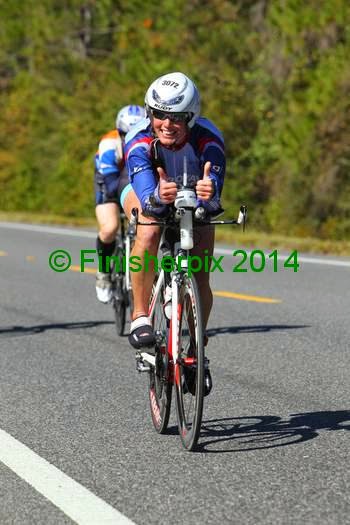
Quite possibly the most enjoyable bike split of any triathlon I have completed :)

It was at the half way point, under 3 hours, that I thought to myself that perhaps a sub 6:15 was possible, I didn't want to pile the pressure on and then be disappointed as I had no idea how my legs were going to hold up. So, at every 10 mile marker, I was amending my goal and that was driving me on. With 90 miles down I decide sub-6 was possible and decided to go for it. I felt so comfortable on my trusty Merv, only adjusting within the aero position to stretch out my shoulders every so often. My nutrition went well, I stuck to the plan most of the time but adjusted for what I felt like. For example I picked up some bananas segments a few times as I was completely fed up with Powerbar drink! I think that is important in any race; remaining flexible is the key! Coming in off the bike, my legs felt good. Transition was only 4 mins in total; I don't like to 'faff' about; I'm too impatient to get on the run! I decided against socks on the bike as I had toe covers but also I thought that I'd appreciate fresh socks on the run. So, shoes on, watch lapped and the longest wee ever! Haha! (I didn't stop on the bike at all) and then out in to the big cheering crowd, completely pumped that I had made it in not just under 6 hours, but in 5 hours and 50 minutes! Boom!

Out on the run: oh I felt so so good the first half marathon. I was holding a slightly quicker pace than planned but my lungs weren't working overly hard and my legs felt strong. At the 14 mile point however, my hips/pelvis started hurting. After evaluating the race since, I think it was due to being in the aggressive TT position the whole time. I experienced this pain in my last long run off of Merv, which I never did on my Cervelo. I think it just such a big change in the position, which I haven't trained with all year. Also, I knew I had pushed hard on the bike (I remember wondering about how my run performance would be affected as I felt my quads working hard whilst pedalling!). Despite my nutrition plan, I switched to just water on the run; my abdomen ended up so bloated and a little painful toward the end. I knew I had it in me to go faster but my pelvis was so painful. Seeing Chris, Toby and the lovely Nicky (who also travelled down from Pensacola to watch me race) at the 13 mile point was a great boost (much better than my honey sandwich which was rather disappointing and quite dry!)


Strangely I also found myself tired, as in proper eyes-drooping-shut tired, around mile 17. I'd never experienced that on training but then I supposed I was never 'that' fatigued! I found myself a little emotional at times. Not crying, but almost on the verge - very odd! I'm not a particularly 'teary' sort of person so it it was quite weird to be dealing with it. The last mile I picked up the pace. Adrenaline pumping, I ran past a girl that had been back and forth with me throughout the last 13 miles. She tried attack back with a burst of speed but I picked up the pace and dropped her (yay!). I then put on a bit of a sprint to get past other guys in front of me (I wanted to get a good photo on the finish line! Haha!). It's funny how you have that little extra gear boost when your body overrides all other sensible decision making emotions! 

My actual time was 9:59:47. A huge relief to get under 10 hours!
Crossing over the line, hearing the words ‘You are an Ironman’, it was a bitter-sweet experience as I’m ‘not quite an Ironman’ yet; more of a ‘Tin-man’ (as my husband likes to call me). There were some big lessons learnt from my race, especially on the run. On other hand, there were also some big positives from it too. For the most, my well structured, thought out plan worked; I felt completely calm and in control throughout and changes I made took into consideration how the race was proceeding. 


An emotional reunion with Chris
I found myself, half way through the run route, deciding never to do Ironman again, but I know I need to do a full race before I’m happy. But you all knew that, hey?! 

The smile says it all really....!
So now it is into recovery for a few weeks. Teaching my spin classes and going for a run, swim or cycle at a 'relaxed' pace. I'm taking the time to enjoy all three of my favourite sports again. Oh and getting some good stretching in! It's time for Team Wilcox to take a break both physically and mentally and get some time in as a family. Time to enjoy some lazy Sundays filled with hiking and pancake eating, rather than 4 hour bike rides and Power-bar eating! 

I owe a huge debt of gratitude for those of you who have joined me on this journey. My awesome coach Stefan Lawrence of tri-sl-training, my family (indeed, my grandparents who flew all the way from the UK to watch me race at Tahoe!), my friends who have followed my progress through the year and those of you who so kindly sat, glued to your computers, to follow me throughout the race and watch me cross that line and Nicky who drove all the way down to PCB and braved it through the long hours of spectating. However, not even one step of this fantastic journey could have been started if it weren't for my fabulous boys: my supportive, loving and generally fantastic husband (and in-house bike mechanic) Chris, my inspiration Turbo Toby and stepson Ross (who is renowned for asking me if I could 'just swim faster' whilst he was paddle-boarding next to me in Lake Tahoe). 

Its time to keep working towards the next goal; an exciting voyage though the next chapter, taking the high and lows of what dreams, tears, sweat and laughter give us. 

A small sign I found at the race expo summed it up really: 

'Only those who risk going too far, can possibly find out how far one can go' - T.S. Eliot

Until next time friends,


TF
x